
Echoes of Change: The Journey of Radio and Sound Recording
Radio and the sound recording industry are two of the most influential media forms in modern history. Their development has been shaped by key figures, technological innovations, and important regulatory decisions. From Marconi’s first wireless transmissions to the emergence of streaming platforms, the progression of these industries reflects not only changes in technology but also shifts in economic and cultural dynamics. This writing project explores the history and development of radio and sound recording, examines the impact of early regulatory decisions, and discusses how contemporary technological convergence is transforming both industries.
The history of radio begins with pivotal figures like Guglielmo Marconi, Nikola Tesla, Reginald Fessenden, and Lee DeForest. Marconi is often considered the "Father of Radio" due to his successful wireless transmission of signals across the English Channel in 1899 and across the Atlantic in 1901. Marconi's innovations allowed for the first instances of long-range wireless communication, setting the stage for modern radio. Meanwhile, Tesla's contributions, though often overshadowed by Marconi, involved his pioneering work in electromagnetic fields and radio waves, which laid the foundation for wireless communication. Reginald Fessenden made another crucial breakthrough in 1900 when he invented the liquid barretter, the first audio device capable of receiving wireless voice transmissions. This invention marked the beginning of audio radio, allowing people to hear voices transmitted through the air, not just Morse code.
Lee DeForest further advanced the field with the invention of the Audion tube in 1906. This vacuum tube amplified weak radio signals, making it possible to send clearer audio over greater distances. DeForest’s invention was a game-changer for both radio broadcasting and the sound recording industry, as it allowed for the amplification of recorded sounds.
As radio technology developed, so did the need for regulation. For example, the Radio Act of 1910, known as the Wireless Ship Act, required ships carrying more than 50 passengers to have a functioning wireless telegraph system. This was prompted by the sinking of the Titanic, which highlighted the necessity for effective communication at sea. Consequently, the subsequent Radio Act of 1912 further solidified these rules and introduced the requirement that wireless operators be licensed by the Secretary of Commerce and Labor. These regulations helped prevent interference and ensured that operators were qualified, creating a more reliable and safer environment for wireless communication. Moreover, in 1927, the Radio Act introduced the concept of broadcasters as "caretakers" of the airwaves, with the Federal Radio Commission (FRC) overseeing broadcasting licenses. The Communications Act of 1934 later established the Federal Communications Commission (FCC), which still regulates radio today. These laws shaped the economic structure of radio by prioritizing the public interest, with broadcasters serving specific communities but adhering to national guidelines. Thus, these regulatory frameworks established the foundation for a system in which broadcasters were private, commercially owned enterprises that had to balance the economic realities of advertising with the public interest. Advertising became the primary source of revenue, driving the content produced by radio stations. National networks began to dominate the most lucrative broadcasting hours, influencing the kinds of programming that would reach the largest audiences.
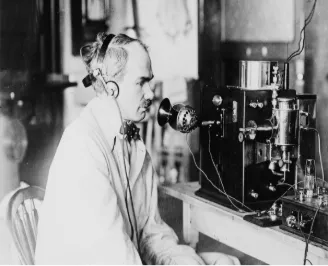
"Lee DeForest", Photo by Bain News Services, no date
recorded, taken from the library of congress
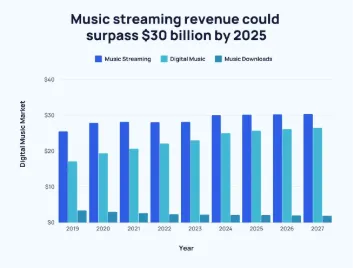
Economic Structure
The organizational and economic structures of the contemporary radio and sound recording industries continue to shape the content we hear today. For instance, commercial radio stations are licensed to serve specific localities but are often part of larger national networks, which focus on programming that attracts the most listeners. A prime example of this is iHeartMedia, which operates over 850 radio stations in the U.S., providing a mixture of news, entertainment, and music programming targeted to broad national audiences. On the other hand, local radio stations serve their specific communities with a more tailored approach. These stations often offer local news, weather updates, and programming that reflects the local culture, attracting advertisers who prefer to target a regional audience. Additionally, local stations typically offer lower ad rates, making it easier for small businesses to advertise. The recording industry, which has long been intertwined with radio, also has its organizational complexities. The major record labels—Universal Music Group, Sony Music, and Warner Music Group—control a large portion of global music distribution. These labels work closely with radio stations to promote new music, and the economic structure of the industry revolves around selling music through both physical formats and digital downloads. However, with the rise of streaming platforms like Spotify, Apple Music, and YouTube, the dynamics of the music industry are changing, as listeners move from purchasing physical records or downloads to subscribing to services that offer unlimited access to music. Despite this shift, there are still artists who prefer traditional formats like CDs.
For example, my brilliant brother-in-law, a Harvard graduate with a Ph.D. in psychology from Fordham University, exemplifies the enduring appeal of CDs. A singer-songwriter and multiple-time winner of the New Mexico Music Awards, he has been musical from birth and continues to produce and sell CDs despite the industry's shift to digital formats. While many musicians no longer produce CDs and new cars are often designed without CD players, he remains committed to this traditional format. I've recommended that he explore modern music streaming services such as Spotify, Pandora, and SoundCloud to modernize his approach, but he values the tangible connection CDs provide. This highlights how, even in the digital age, some artists choose to create and distribute music through legacy formats, staying true to their preferences and creative processes.