To make my explanation more relatable, I ask: have you ever seen the opera Medea, where Maria Callas plays the title role? Medea was the first Georgian immigrant who left her homeland and chose love over her father and brother. Or have you heard the story of the Argonauts, when Jason, a Greek hero, traveled to Colchis (ancient Georgia) to steal the Golden Fleece from King Aeetes? Medea, the king's daughter, fell in love with Jason and helped him steal the Golden Fleece. She then fled with him to Greece. Medea is one of the most famous Georgians in the world. While people might not know about Medea, some Americans may know about Stalin, who was born in Gori, Georgia. But he is not a figure we celebrate. Stalin’s oppressive role in our history deeply shaped Georgia’s fate under the Soviet Union.
Georgia was occupied by the Red Army of Soviet Russia in 1921. The country lost its independence and the opportunity to build a democratic and free society for nearly 70 years. Soviet policies dismantled Georgia's aspirations for autonomy and self-determination. Pro-independence parties were banned, dissidents were persecuted, and "artificial" autonomies were created in regions like South Ossetia and Abkhazia. Stalin’s involvement was pivotal. In 1922, he supported the "autonomization" project, which reduced Georgia to an autonomous republic within the Russian Federation rather than an independent Soviet Republic. He crushed pro-independence movements, labeling opposition as "Georgian chauvinism."
Despite these challenges, Georgians never stopped fighting for freedom. On April 9, 1989, the Soviet Union’s Red Army violently dispersed a peaceful protest in Tbilisi, killing 21 young people. This tragedy marked the beginning of the end for Soviet rule, and on April 9, 1991, Georgia declared its restored independence. The collapse of the Soviet Union on December 26, 1991, marked a new chapter for Georgia.
Another prominent figure Americans might know is Mikheil Saakashvili, Georgia’s third president. A Columbia University graduate, Saakashvili has always been my idol. Before him, Georgia struggled with electricity shortages and corruption. Thanks to his leadership during the Rose Revolution in 2003, Georgia underwent transformative reforms. He rebuilt infrastructure, rooted out police corruption, attracted foreign investment, and improved public services. Under his presidency, even George W. Bush visited Georgia. However, Saakashvili’s defiance of Putin’s invasion of Georgia in 2008 ultimately led to his imprisonment under a pro-Russian government.
I was born in Tbilisi, Georgia’s capital, during the Soviet Union era. My biological mother abandoned me in the hospital, but I was taken in by adoptive parents who were both blind. Fortunately, my brilliant grandmother stepped in to raise me, becoming like a mother to me. She introduced me to the Georgian alphabet at five years old, a challenging but rewarding process. Her dedication instilled in me a deep love for education.
Enrolling a five-year-old in school during the Soviet Union’s collapse was no easy feat. My grandmother secured special permission from the Ministry of Education, ensuring I could start school early. She was a breast cancer survivor and feared no one else would guide me if she passed away. Her determination taught me resilience and the value of seizing opportunities.
The transition to independence brought poverty and instability. Breadlines were endless, and my grandfather often prioritized books over basic necessities. One unforgettable evening, my grandmother gave him money for bread. Instead, he came home with Dante Alighieri’s Divine Comedy. That night, we ate old bread but began reading together. This moment taught me that knowledge and imagination were worth more than material comforts.
Our family library became my sanctuary. Filled with works by Georgian, Russian, German, English, and Italian authors, it sparked my lifelong love of storytelling. I worked hard in school, often ranking among the top students. Education was my path to a better life, even as the school system discouraged critical thinking. I constantly challenged my teachers, some of whom encouraged my inquisitiveness by letting me act as the "teacher" in class.
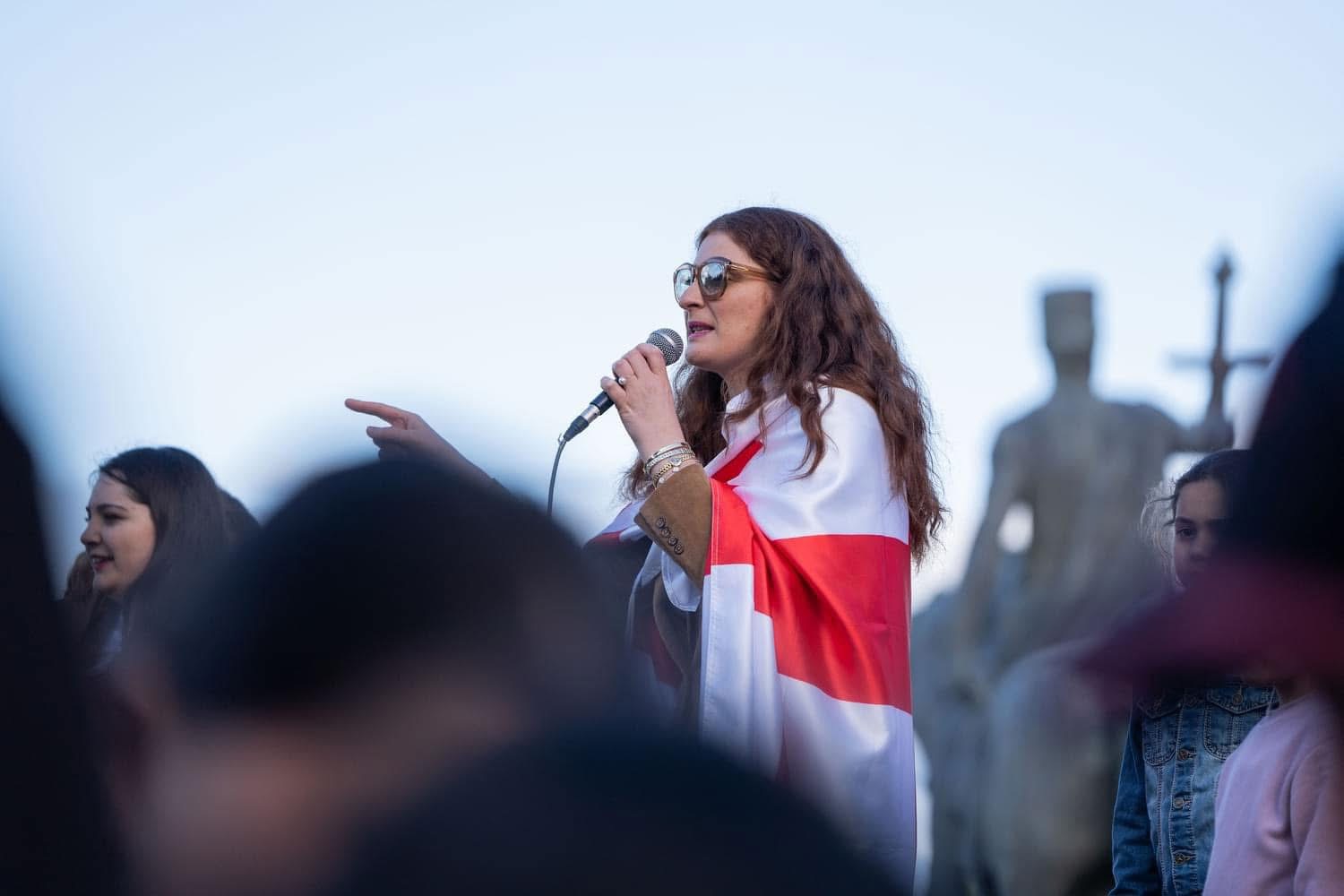
Since childhood, I dreamed of becoming a journalist. I would hold a hairbrush as a microphone, announcing, "Attention, attention, it’s news time! Tsisnami Sakvarlishvili speaks!" My family endured electricity shortages, but I would study by candlelight and eagerly read newspapers and magazines. Watching Inga Grigolia, the evening news host on Georgia’s single public channel, inspired me. My dream of reporting news blossomed in those candlelit nights.
In my career, I have worked with notable organizations such as Editori.ge, Goga TV, and Paese Sera Toscana, contributing to news, stories, and reports that connect audiences to critical issues. These platforms allowed me to bridge the gap between Georgia and the wider world. Additionally, I maintain my blog, Tsisnami (tsisnami.blogspot.com), where I share my personal experiences, cultural insights, and reflections on Georgian identity.
Today, as I navigate life in the United States, I strive to share Georgia’s rich history and culture with a broader audience. Through my storytelling, I hope to give voice to my homeland and inspire others with the resilience of the Georgian spirit.