Before I can speak about modern reforms, wars, and democratic struggles, I must first help readers understand where my country comes from.
Georgia lies between the Black Sea and the Caspian Sea, at the crossroads of Europe and Asia. It is bordered by Russia to the north, Azerbaijan to the east, Armenia and Turkey to the south, and the Black Sea to the west. Despite its geographic closeness to Russia, Georgia has always preserved its own cultural and historical identity.
To make this history more relatable for American readers, I often begin with stories they may already recognize.
Many people know the opera Medea, famously performed by Maria Callas. The heroine, Medea, comes from ancient Colchis — today’s western Georgia. In Greek mythology, the hero Jason traveled to Colchis in search of the Golden Fleece. Medea, the daughter of the king, helped him and left her homeland for love. In many ways, she can be seen as one of the earliest symbolic Georgian migrants.
While many Americans may not recognize Medea as Georgian, they often recognize one name associated with my country — Joseph Stalin, who was born in Gori. He is not a figure Georgians celebrate. His legacy is deeply connected to one of the most painful chapters of our history.
In 1921, Georgia was occupied by the Red Army of Soviet Russia. Our country lost its independence and the chance to build a democratic society for nearly seventy years. Political parties were banned, dissidents were persecuted, and so-called “autonomies” were imposed in regions such as South Ossetia and Abkhazia — divisions that still affect Georgia today.
Stalin personally supported policies that weakened Georgia’s political status within the Soviet system and crushed pro-independence movements by labeling them “nationalist” and dangerous.
Yet Georgians never stopped resisting.
On April 9, 1989, Soviet troops violently dispersed a peaceful demonstration in Tbilisi, killing 21 young people. That tragedy became a turning point in our modern history. Exactly two years later, on April 9, 1991, Georgia restored its independence. The collapse of the Soviet Union at the end of that year opened a new chapter — but not an easy one.
Another name that many Americans may recognize is Mikheil Saakashvili, Georgia’s third president and a graduate of Columbia University. For me, he represented hope for a new Georgia.
After the Rose Revolution of 2003, his government introduced sweeping reforms. Corruption in the police was dismantled, infrastructure was rebuilt, public services were modernized, and Georgia began to attract international investment. For the first time in many years, people could see real change in their daily lives. During this period, George W. Bush even visited Georgia, a powerful symbol of international recognition.
However, Georgia’s refusal to submit to Russian pressure came at a high price. After Russia’s invasion of Georgia in 2008, Saakashvili became a political target under a pro-Russian government and was later imprisoned.
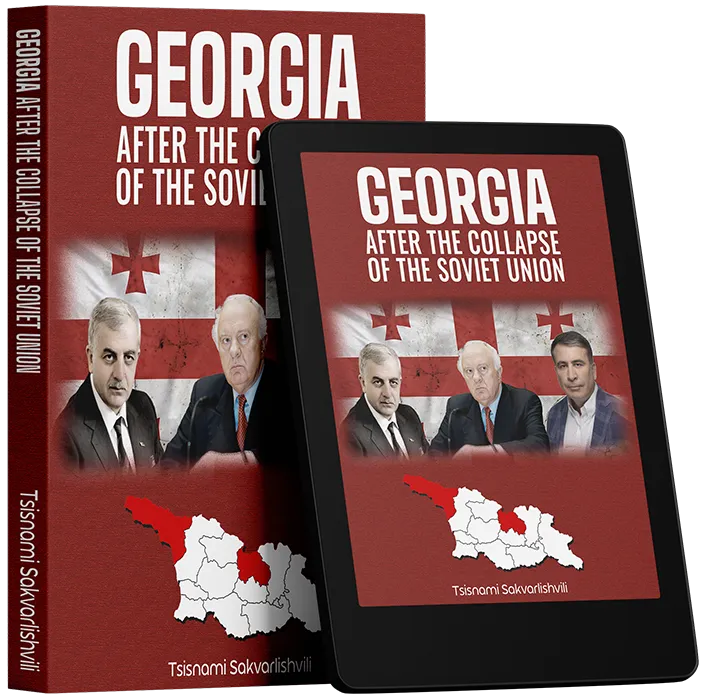
All of these experiences — personal and national — are the reason I wrote my third book, Georgia after the Collapse of the Soviet Union, which is also my first book in English.
My goal is to speak directly to American readers and explain not only what happened to my country, but why it still matters today.
The fight for freedom in Georgia is not over. Even now, Georgian citizens gather every night in front of the parliament to protest a pro-Russian government and defend democratic values. I stand with them. I personally led protests and rallies during the summer of 2024 and again in January 2025.
I wrote this book because I believe that when democracy is under attack, silence becomes dangerous.
When democracy is under attack, we must stand up — and fight back.
With this book, I want Americans to understand that Georgia is not simply a small country near Russia. It is a nation that has paid a very high price for its freedom — and is still paying it today.
With love,
Sissy