Georgia’s democratic aspirations have been undermined since 2012 by the influence of the Russian oligarch Bidzina Ivanishvili, founder of the Georgian Dream Party — often derisively called the “Russian Dream” because of its sympathetic pro-Russian ties. Ivanishvili’s administration prioritizes preserving his wealth, which he amassed during the 1990s in Russia, over Georgia’s aspirations to join the European Union and NATO. This pro-Russia stance has led to widespread discontent and an exodus of Georgians seeking better opportunities abroad.
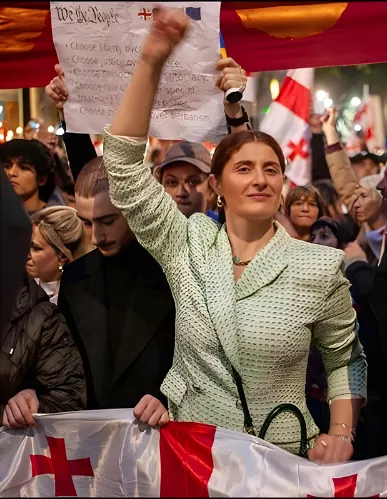
Public outrage reached a boiling point in the spring of 2024 when the Georgian Parliament passed a controversial “foreign agents” bill, widely criticized as a tool for suppressing dissent. Allegations of election fraud during the elections of Oct. 26, 2024, fueled further unrest. For 58 consecutive days, citizens gathered on Rustaveli Avenue in the nation’s capital, Tbilisi, demanding new elections and the resignation of the Georgian Dream government. The protests have been met with a heavy-handed response. Police have arrested numerous activists, often without cause, and deployed rubber bullets and tear gas to disperse crowds. Despite this, the movement shows no signs of waning.
As a Georgian writer and journalist, I felt a deep sense of duty to stand with my fellow citizens in the fight for our nation’s future. I participated in the protests during May and June 2024, marching alongside thousands of Georgians who share the same dream of freedom and democracy. In January of this year, I returned to Georgia for three weeks and joined the nightly demonstrations on Rustaveli Avenue, lending my voice to the growing demand for change.
During my time in Tbilisi, I helped organize an immigrant march from the Tbilisi Philharmonic to the Parliament building, where we called for new elections and for our country to be free from Russian influence.
“Now, we do not only demand new elections,” said Nadim Khmaladze, a veteran of the war in Ukraine and a vocal supporter of the protests. “We want Georgia free from every pro-Russian politician, including Bidzina Ivanishvili. We need a new government, new pro-Western political parties, and more young people in politics.”
I also participated in the Friends March, a powerful display of unity among people from all walks of life, including a highly active Generation Z.
“We want to live in a free country, integrated with Europe,” said Ketevan Kajaia, a young protester. “Our future depends on it.”
These moments were profoundly moving, as Georgians from across the globe came together to stand up for our shared aspirations. I had the honor of delivering several speeches during these protests, addressing crowds of nearly half a million people. I emphasized that fighting for freedom is the most important value in our lives and called on my fellow Georgians to persist in their pursuit of a brighter future. Additionally, I appeared on multiple political TV shows in Georgia as a political activist, passionately opposing Russian President Vladimir Putin’s politics and advocating for Georgia’s democratic and Euro-Atlantic aspirations.
On Jan. 15, the nation came to a standstill as Georgians staged a three-hour general strike. Businesses, artists, musicians, and theaters joined in solidarity. The artistic and intellectual communities have become a driving force in the protests, using their platforms to amplify calls for change. Immigrants from across the globe have returned to stand with their homeland, highlighting the widespread unity of the Georgian diaspora.
Georgia’s fight for democracy continues with unwavering determination. Protesters are calling not only for new elections but also for the release of political prisoners and the removal of all pro-Russian influences from government. Their ultimate goal: a free, democratic Georgia fully integrated within the European Union and NATO.
“This is not just about politics,” Khmaladze said, “it’s about the soul of our nation and the future of generations to come.”
As the world watches, Georgia’s citizens remain steadfast in their pursuit of freedom, proving that the spirit of democracy cannot be silenced. Their fight serves as a reminder that even in the face of overwhelming odds, the will of the people can prevail.