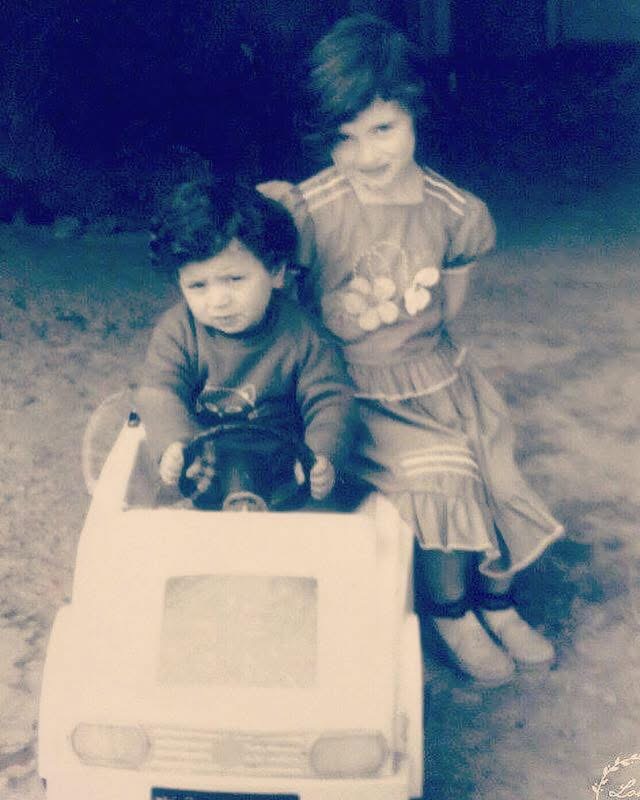
D.H. Lawrence’s “The Rocking Horse Winner” offers a parallel exploration of the effects of nature and nurture on individual development, while also addressing societal pressures such as materialism. The story depicts a young boy, Paul, who is determined to earn his mother’s love and solve his family’s financial woes by supernaturally predicting horse race winners while riding his rocking horse. Despite his success in securing wealth, Paul ultimately sacrifices his health and life, highlighting the destructive impact of societal expectations and familial dynamics. This narrative serves as a lens to examine how both inherited traits and environmental factors shape individual outcomes, resonating with the contrasts between my brother and me.
Although my brother and I were raised in the same home, the contrasting personalities we developed as adults are a result of both nature and nurture. My parents tried for ten years to have a child but were unsuccessful, so they decided to adopt. As D.H. Lawrence writes in The Rocking-Horse Winner, “Nobody ever knows why one person is lucky and another unlucky” (Lawrence). That is when I came into their lives, a two-week-old baby, abandoned by my biological mother and in need of love and care. Two years later, my mother had my brother, and we grew up together. We had different biological parents, and it became clear as we got older that our genes were different. I did not know I was adopted until one day, during a fight with a classmate, she yelled at me, “Your brother isn’t your brother! And you’re not their child!” That was when I realized why my brother and I were so different: our temperaments were shaped by distinct genetic backgrounds.
In addition to our genetic differences, the ways our parents treated us further influenced our emotional development and sense of independence. As Diane E. Papalia and Sally Wendkos Olds explain in “Child-Rearing Styles,” “[A] very important influence on behavioral styles is the early emotional environment - how children are treated by their parents” (Papalia and Olds). Our father, who was blind, and our mother, who had vision problems but could see, both contributed to shaping who we became. My mother, especially, was very protective of my brother, fearing he might have vision problems too. She doted on him, treating him as if he were fragile. She even bought goat milk from our neighbor, believing it would improve his vision, and gave it to him every morning. One day, when I drank some of my brother’s goat milk, my mother got angry and yelled at me, saying it was only for him. At the time, my parents could not afford to buy more, and I did not get the same kind of special care. My brother received all the attention, love, and care from our parents, while I had to make do with less. As a result, he grew up with a sense of dependence, while I developed a strong sense of independence. Without as much attention and protection, I learned to be self-reliant and take risks, which shaped me into someone who constantly seeks personal growth and new experiences.
Our contrasting social experiences also played a significant role in shaping our personalities. Growing up in a small village, Vachnadziani, where it seemed like everyone knew each other, I had the freedom to explore, make friends, and interact with the world outside the house. I spent time with friends playing soccer, swimming in the river, and laughing under the moonlight. These experiences helped me develop social skills and confidence. In contrast, my brother spent much of his time indoors with our mother, which limited his opportunities to connect with other children. At the time, all I could appreciate was that he was getting more attention than I, which impacted my behavior. I would sometimes act melodramatic or fake illness to get attention. Albert J. Bernstein points out in Emotional Vampires that “Histrionics’ desire for attention and approval is so strong that, in their minds, they divide themselves into the parts people like and the parts that are not there” (Bernstein 94). Today, I can see the advantages of how I was raised. I am comfortable meeting new people and forming relationships, while my brother still struggles to step outside his comfort zone. The novel Tuesdays with Morrie, by Mitch Albom explores the human condition, especially relationships and what is important in life. It is my favorite novel, and I believe it shaped my philosophy of life. Many would look back on a childhood like mine bitterly, but I am grateful for the conditions that made me who I am and brought me peace and fulfillment in my adult life. In the book, Morrie says, “Invest in the human family. Invest in people. Build a little community of those you love and who love you” (Albom 157). That is how I try to live my life and will continue doing so. I pity my brother sometimes, but then I realize that he may not even know the difference. He is who he is, and I am who I am. I would not change it.
I understand and accept the differences between my brother and me. We do not have the same biological parents, we were not loved the same way by our parents, and we had different social experiences. Despite our differences, I love my brother dearly. I protect him, and as his older sister, I feel it is my responsibility to look out for him. I will never forget the time a boy called to me and said, “Some boys are biting your brother in the schoolyard.” Without hesitation, I ran downstairs and bit the three boys. From that day on, no one dared touch my brother. Even now, I continue to protect and care for him, even from afar in the United States. I have introduced him to my Georgian friends, and we have welcomed him into our circle. Just as our mother did for him when we were young, I continue to provide goat milk for him.
Works Cited:
Albom, Mitch. Tuesdays with Morrie, Crown, 2022.
Bernstein, Albert J. Emotional Vampires: Dealing with People Who Drain You Dry. McGraw Hill, 2012.
Papalia, Diane E., and Sally Wendkos Olds. “Child-Rearing Styles.” Human Development. 2020.
Lawrence, D. H. “The Rocking-Horse Winner.” The Fiction of D. H. Lawrence: Selected Short
Stories, B&L Associates, Bangor, Maine, U.S.A. 1973. Accessed May 28, 2025.